UC5 — General Failure (EDFS only)
Abstract
Twenty per cent of the constellation produces a small, finite batch of
images each. The whole constellation — both the producing satellites and
every ground station — is hit by a continuous stream of non-terminal
hardware faults (no Destroy). We measure how long it takes for every
produced image to reach at least one ground station, and check whether
EDFS is eventually able to deliver them all in spite of the fault stream.
EDFS only; TUS is out of scope here.
UC5 sits between UC2 (every sat produces one file, faults active) and UC4 (one terminal failure on one producer). It's the long-duration stress test of EDFS's eventual consistency under sustained but non-catastrophic degradation.
Relationship to UC2. UC5 is essentially the same experiment as UC2 —
the same constellation, the same continuous stream of non-terminal hardware
faults (Destroy is excluded in both), measuring the same time-to-ground
KPI — only with a different parametrization: a sparser, time-distributed
workload (only ~20% of satellites produce, each a small finite batch of
images over time, instead of every satellite producing one file at t=0)
and a stricter 100% completeness bar. The one practical consequence worth
calling out is that UC5 is EDFS-only, so there is nothing to compare
against: there is no point-to-point (TUS) baseline here, because the
eventual whole-set convergence under sustained relay has no point-to-point
analogue (TUS would simply lose files under the fault stream). UC5 is
therefore an absolute characterization of EDFS across the RF axis rather
than a head-to-head.
Success Condition
The run ends successfully once a single ground station holds every image produced in the run.
Detailed description
Out of the sat_count satellites in the constellation, exactly 20%
are designated producers. Each producer's agent writes N=5 images
spaced by IMAGE_INTERVAL (default 2m), then exits. The total number
of distinct files in flight per run is therefore floor(0.2 * sat_count)
* 5 — finite and countable, as required.
While the run is in progress, the operator stamps a per-fsNode random
fault schedule on every fsNode (producers, relays and ground stations
alike). Allowed fault types: NetworkBandwidthReduced, NetworkFailure,
DiskFull, DiskFailure. Destroy is explicitly excluded — the
whole point of UC5 is to study eventual delivery under transient
degradation; a destroyed producer of a file with RF=1 (no copies yet)
would be UC4's loss-mode and would muddy the metric.
The seven ESTRACK ground stations receive on all files (their agent does not exit on first RECEIVED — it keeps logging until the run ends).
The run ends when (a) every file has been received by at least one GS, or
(b) maxDuration fires. Both outcomes are reportable.
Main goal
Show that EDFS eventually delivers every file under sustained non-catastrophic faults, and quantify "how long is eventual?":
delivery_success_rate = (distinct files delivered to ≥1 GS) /
  files_produced
, withfiles_produced = floor(0.2·sat_count)·5. Target ≥ 95% (atRF ≥ 3).- Time-to-all-delivered when the run terminates by (a).
- The trade-off between
RFand total energy / network spent: higherRFshould improvedelivery_success_rateat the cost of more cross-talk on inter-satellite links.
KPI:
delivery_success_rate ≥ 95%atRF ≥ 3for every testedsat_count.- Time-to-all-delivered grows sub-linearly with the number of files in flight.
Parameters
| Parameter | Values | Notes |
|---|---|---|
engine |
edfs only |
TUS would simply lose files under faults; out of scope. |
sat_count |
1, 2, 8, 21 | Capped at 21 so every run fits a small (single-node-class) test cluster; the large-constellation points (100 / 200) are out of scope for this sized-down sweep. sat_count=1 degenerates to "one producer, no relays" — a sanity-only data point. |
producer_fraction |
fixed at 20% | producers = max(1, floor(0.2 * sat_count)). For sat_count=1/2 the floor gives 1; for sat_count=8 it's 1 (floor(1.6)=1); for sat_count=21 it's 4. |
files_per_producer |
5 | Bounded, so we can compute completion rate cleanly. |
image_interval |
2m |
Spreads file births in time so the network has work to do throughout the run. |
file_size |
32M |
Small enough that several files can be in flight simultaneously without strangling the bandwidth model. |
RF |
1, 3, 5 | The headline EDFS knob. |
priority |
default |
Priority handling is UC3's question, not UC5's. |
gs_count |
fixed at 7 (ESTRACK) | |
fault_intensity |
mean interval 5m, jitter 50%, duration 30-60s |
Same recipe as UC2, encoded directly in each behaviour's hardwareEvents.schedule with a per-run seed. |
max_duration |
8h |
Long-duration stress test by design. |
Assumptions
- The inter-ground-station network is broadband and disturbance-free. Every
pair of ground stations is treated as permanently linked, independent of
orbital line-of-sight: the link is fixed at 10 Gbit/s with zero packet loss,
and only its propagation delay scales with the great-circle distance between
the two stations. Satellite links, by contrast, exist only while the two nodes
are in line-of-sight and their bandwidth degrades with distance. The only event
that can disturb a ground-station-to-ground-station link is a hardware failure
injected as a
HardwareEvent(e.g.NetworkFailureorNetworkBandwidthReduced) on one of the two stations.
Additional metrics
Beyond yass_file_delivery_seconds:
delivery_success_rate—count(distinct file names delivered to ≥1 estrack GS) / total_files_produced, with the deterministictotal_files_produced = floor(0.2·sat_count)·5. Source:events-csv/file_delivered.csv(numerator = distinctnamewheretargetstarts withestrack). Do not useyass_file_received_total{is_target_gs="true"}— that label does not exist on the metric and it counts receive events, over-counting repeated GS receipts (> 1.0).- "Eventual completion" plot: cumulative
delivery_success_rateas a function of wall-clock time. We expect a smooth monotonic climb that asymptotes at or close to 1.0 forRF ≥ 3. yass_edfs_replica_completenessheatmap per CID — over a long stress-test run we expect "full replicas" to grow steadily as DHT pickups absorb each file.- Per-fsNode resource cost over the long run:
yass_container_cpu_millicores,yass_container_memory_bytes,yass_network_tx_bytes_total. - Total network cost:
sum(yass_network_tx_bytes_total)aggregated over the whole constellation. Headline trade-off metric for theRFsweep — the byte volume should grow roughly linearly withRFwhile the completion time should drop. - Fault-overlay correlation:
yass_hardware_event_activeas a state timeline so we can visually correlate fault windows with stalled per-file progress.
Charts
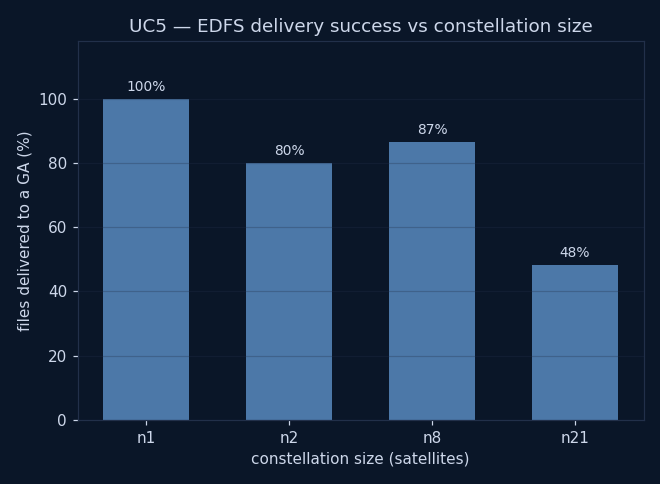
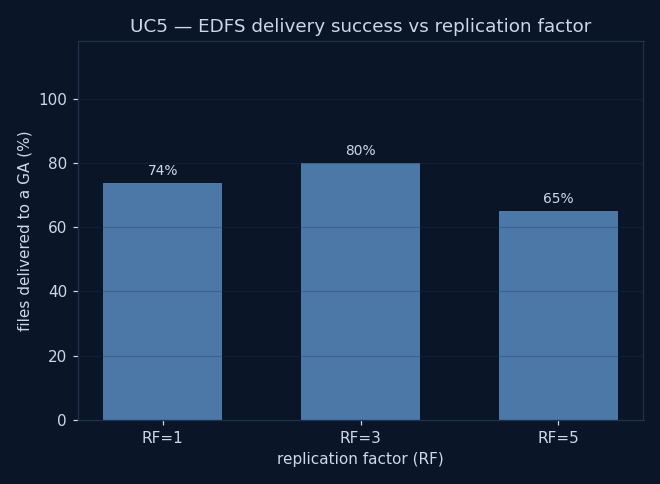
Variants (8)
| variant | engine | sat | RF | produced | files→GS | all? | lastGS(s) | status | delivered % |
|---|---|---|---|---|---|---|---|---|---|
| uc5-edfs-n01-rf1 | edfs | 1 | 1 | 5 | 1 | no | 570 | Success | 100% |
| uc5-edfs-n02-rf1 | edfs | 2 | 1 | 4 | 1 | no | 508 | Failed | 80% |
| uc5-edfs-n08-rf1 | edfs | 8 | 1 | 5 | 1 | no | 411 | Success | 100% |
| uc5-edfs-n08-rf3 | edfs | 8 | 3 | 4 | 1 | no | 360 | Failed | 80% |
| uc5-edfs-n08-rf5 | edfs | 8 | 5 | 4 | 1 | no | 365 | Failed | 80% |
| uc5-edfs-n21-rf1 | edfs | 21 | 1 | 17 | 2 | no | 113 | Failed | 15% |
| uc5-edfs-n21-rf3 | edfs | 21 | 3 | 16 | 4 | no | 518 | Failed | 80% |
| uc5-edfs-n21-rf5 | edfs | 21 | 5 | 17 | 4 | no | 703 | Failed | 50% |