UC3 — Priority-Aware Routing (EDFS only)
Abstract
One satellite produces one large file. We re-run the same scenario for each
of the three file priorities (low, default, high) on the same
constellation topology and measure how long it takes the file to reach at
least one ground station. The hypothesis is that the EDFS engine treats
high-priority files preferentially (faster replication, less aggressive
back-off under congestion), so a high-priority file should arrive
measurably faster than a low-priority one on otherwise identical runs.
This use case targets only EDFS — TUS has no notion of file priority on the wire, so the comparison is internal to EDFS, not engine-vs-engine.
Success Condition
Same mechanism as UC1: the run ends successfully the moment the first file reaches any ground station.
Detailed description
A single producer satellite writes one large file. The producer's agent
sets FILE_PRIORITY to one of low, default, high and writes a
.priority sentinel that fs_engine_wrapper propagates into the
file's Attributes map (read by EDFS at replication time).
For each constellation size we run three back-to-back experiments — one per
priority value — with deterministic simulationStartTime so the orbital
pass schedule and the GS visibility windows are bit-identical between runs.
Anything different that we observe in time-to-first-delivery is then
attributable to the priority handling, not orbital luck.
The seven ESTRACK ground stations are the receivers; each terminates on
the first RECEIVED with the configured END_ON_ANY=true.
Main goal
Establish a quantitative answer to: does EDFS's priority handling actually move the needle? Specifically:
- Time-to-first-delivery of a
highfile is statistically lower than that of alowfile at every sat_count we test. - The ordering
high < default < lowis preserved at every sat_count (monotonic). - The effect should grow with sat_count: more peers → more chances for the priority weighting to win the next-hop selection race.
KPI: time_to_first_GS_delivery — at sat_count ≥ 8,
first_GS(high) ≤ 0.80 × first_GS(low) (high-priority delivers at least
20% faster than low — meaningful routing-preference, not noise).
Secondary: priority monotonicity first_GS(high) ≤ first_GS(default) ≤
first_GS(low) at every sat_count.
Parameters
| Parameter | Values | Notes |
|---|---|---|
engine |
edfs only |
TUS has no priority semantics — out of scope. |
priority |
low, default, high |
The variable of interest. |
sat_count |
1, 2, 8, 21, 100, 200 | Same Walker sweep as UC1. |
RF |
fixed at 3 | A single RF value isolates the priority effect; sweeping both would confound the analysis. |
gs_count |
fixed at 7 (ESTRACK) | |
file_size |
256M (spec: 1G) |
Executed at 256M. The UC was specified at 1G — "large" so the transfer spans many passes and the priority weighting becomes visible (a tiny file delivers in one bounce, hiding priority). At 256M the transfer is ~4× shorter, weakening the priority signal: scope UC3 conclusions to the "256M regime" or re-run at 1G. |
simulationStartTime |
fixed across the three priority runs of one sat_count | Cancels orbital luck. Use the same pinned epoch as UC1 (2026-05-16T23:59:00.000Z) unless a sat_count needs a different one. |
max_duration |
4h |
Generous: large file × low priority × no faults could still take a while. |
Assumptions
- The inter-ground-station network is broadband and disturbance-free. Every
pair of ground stations is treated as permanently linked, independent of
orbital line-of-sight: the link is fixed at 10 Gbit/s with zero packet loss,
and only its propagation delay scales with the great-circle distance between
the two stations. Satellite links, by contrast, exist only while the two nodes
are in line-of-sight and their bandwidth degrades with distance. The only event
that can disturb a ground-station-to-ground-station link is a hardware failure
injected as a
HardwareEvent(e.g.NetworkFailureorNetworkBandwidthReduced) on one of the two stations.
Additional metrics
Beyond the headline yass_file_delivery_seconds (with the priority label
exposed by the producer's agent on its own metrics):
- Throughput envelope:
rate(yass_network_tx_bytes_total)over the producer's run, plotted side-by-side per priority. We expect higher effective throughput forhigh. - Per-priority resource cost: total CPU and memory aggregated per run. Important because faster delivery shouldn't come at unreasonable cost.
- Total network cost per priority:
sum(yass_network_tx_bytes_total)over the whole constellation. We expecthighto ship roughly the same byte volume aslow(the file is the same size); a meaningful difference here would mean the priority handling is also affecting redundant transmissions, which is worth flagging. - Block-level pickup rate on EDFS Tier-2 Loki events (
edfs_block): for the same file at different priorities, how quickly does each block get pulled by peers? Direct signal of routing preference.
Charts
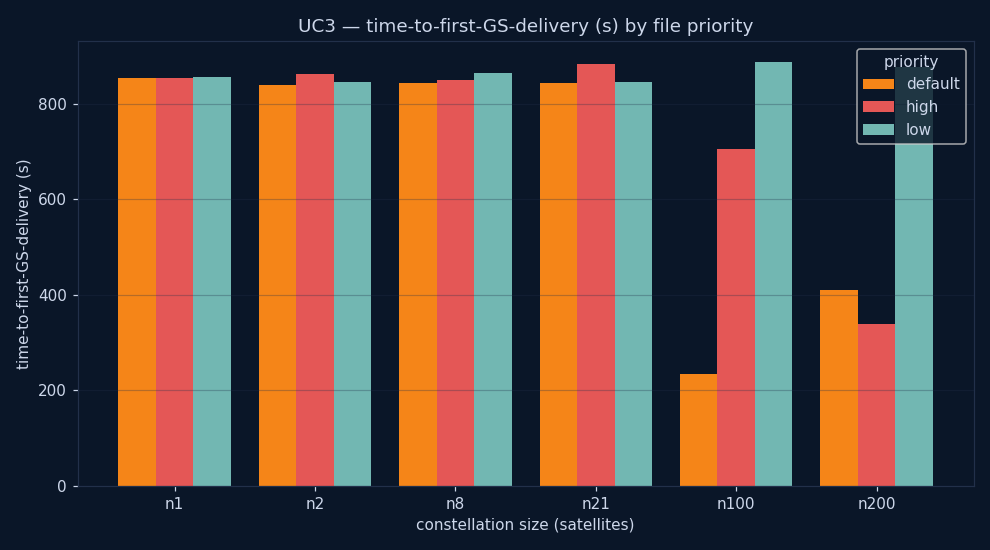
Variants (18)
| variant | engine | size | priority | sat | RF | firstGS(s) | state |
|---|---|---|---|---|---|---|---|
| uc3-edfs-pdefault-n01-rf3 | edfs | 256M | default | 1 | 3 | 854 | Success |
| uc3-edfs-phigh-n01-rf3 | edfs | 256M | high | 1 | 3 | 854 | Success |
| uc3-edfs-plow-n01-rf3 | edfs | 256M | low | 1 | 3 | 855 | Success |
| uc3-edfs-pdefault-n02-rf3 | edfs | 256M | default | 2 | 3 | 839 | Success |
| uc3-edfs-phigh-n02-rf3 | edfs | 256M | high | 2 | 3 | 862 | Success |
| uc3-edfs-plow-n02-rf3 | edfs | 256M | low | 2 | 3 | 846 | Success |
| uc3-edfs-pdefault-n08-rf3 | edfs | 256M | default | 8 | 3 | 844 | Success |
| uc3-edfs-phigh-n08-rf3 | edfs | 256M | high | 8 | 3 | 849 | Success |
| uc3-edfs-plow-n08-rf3 | edfs | 256M | low | 8 | 3 | 865 | Success |
| uc3-edfs-pdefault-n21-rf3 | edfs | 256M | default | 21 | 3 | 844 | Success |
| uc3-edfs-phigh-n21-rf3 | edfs | 256M | high | 21 | 3 | 883 | Success |
| uc3-edfs-plow-n21-rf3 | edfs | 256M | low | 21 | 3 | 846 | Success |
| uc3-edfs-pdefault-n100-rf3 | edfs | 256M | default | 100 | 3 | 234 | Success |
| uc3-edfs-phigh-n100-rf3 | edfs | 256M | high | 100 | 3 | 705 | Success |
| uc3-edfs-plow-n100-rf3 | edfs | 256M | low | 100 | 3 | 887 | Success |
| uc3-edfs-pdefault-n200-rf3 | edfs | 256M | default | 200 | 3 | 409 | Success |
| uc3-edfs-phigh-n200-rf3 | edfs | 256M | high | 200 | 3 | 338 | Success |
| uc3-edfs-plow-n200-rf3 | edfs | 256M | low | 200 | 3 | 877 | Success |